It’s the right time
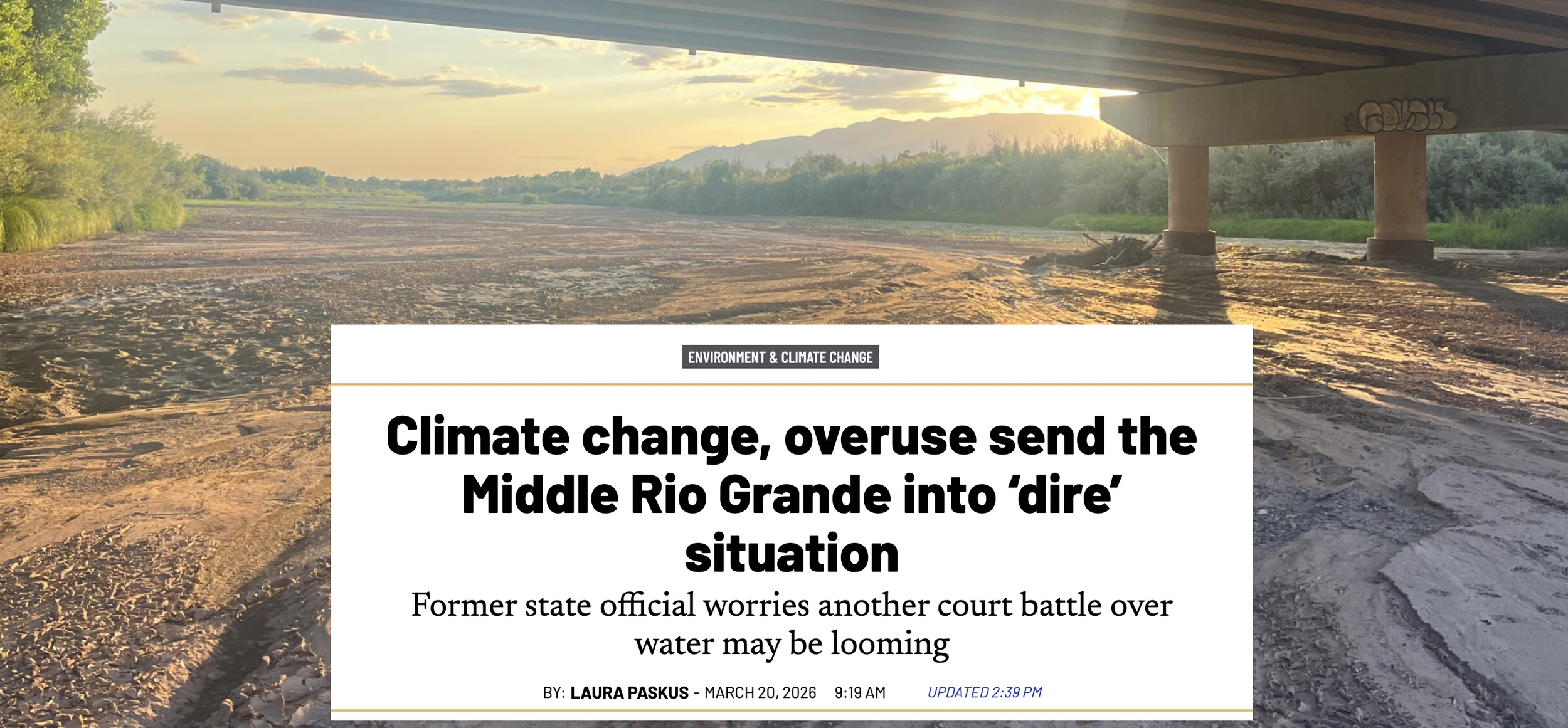
Last week, I reported and wrote a story about impending drying in the Middle Rio Grande. You can read the story over on Source New Mexico’s website.
The take home points? The Middle Rio Grande will start drying soon. As it gets hotter and drier, the bosque and communities near it will be increasingly vulnerable to wildfire. Farmers aren’t going to get much water. Wildlife and ecosystems will suffer.
Why is this happening? In part because:
The climate is warmer and the Southwest is drier.
We expect too much water from the Rio Grande, and we use too much water from the Rio Grande.
There are lots of other things I couldn’t fit into a relatively short news story so over the next few days I’ll be sharing more from that reporting.
First up, is something that Jason Casuga, chief engineer and CEO of the Middle Rio Grande Conservancy District talked about last week.
“If the river’s dry in Albuquerque, the only entities that are probably getting consistent surface irrigation water are the six Middle Rio Grande Pueblos,” he said. Under the rules of western water appropriations — which are akin to private property rights — the senior water rights of tribes must be respected.
Although the people who drew up the Rio Grande Compact in the early 20th century didn’t seek, consider, or allow tribal input or concerns, the Six Middle Rio Grande Pueblos have senior water rights — and have continually asked for a greater role in decision-making on the river.
For those unfamiliar with the Pueblo’s “prior and paramount” water rights in the Middle Rio Grande: See Dani Prokop’s 2022 story in Source NM for a bit more context or read MRGCD’s water distribution policy here. You can also find Josh Mann’s 2007 legislative and administrative history involving El Vado Reservoir here.
“The Pueblos’ water rights are based upon laws spanning hundreds of years and several crowns,” Mann wrote in his 2007 overview, adding that in 1928, Congress protected the prior and paramount rights to the waters the Six Middle Rio Grande Pueblos needed to irrigate their lands.
Because New Mexico has failed to adjudicate water rights in the Middle Rio Grande, this line in Mann’s history is still true almost 20 years later: “However, even today the full extent of the Six Pueblos’ water rights has yet to be determined.”
Of course, underlying a story like the one I wrote last week is another grievous fact: rivers in New Mexico don’t have rights to their own waters. We listen when rivers flood. We don’t seem to listen when they dry.
A few people have scoffed or chuckled when I say I’m working on a project about a better future for the state’s rivers, and when I talk about environmental flows. (And of course, some people just get mad or defensive or offended.)
The other night, I watched two films with a theatre full of people who seemed to be yearning to protect New Mexico and its waters, communities, landscapes, and wildlife. (The two films were Glen Canyon Rising from Crow Canyon Archaeological Center and What the River Knows from the Glen Canyon Institute.)
Afterwards, I was lucky enough to chat with Zanna Stutz, program director with the Glen Canyon Institute; writer John Fleck; and Aidan Manning, rivers and waters program associate with New Mexico Wild.
And I keep thinking of something Aidan said: “Generally, landscapes are much more efficient at storing water than humans are.”
I’ve covered drying in the Middle Rio Grande for 24 years, and I’ve heard all the reasons New Mexico can’t better protect its largest river: This isn’t the right time. There’s not enough funding. There’s not enough water. The public can’t care about something like environmental flows when wars rage, food and gas prices rise, and people feel distrustful, uncertain, or enraged with one another.
I get it.
But this is the right time.
Because it’s never going to get easier to protect our rivers — and everyone who depends on them.
