‘We kept it looking like things were normal.’
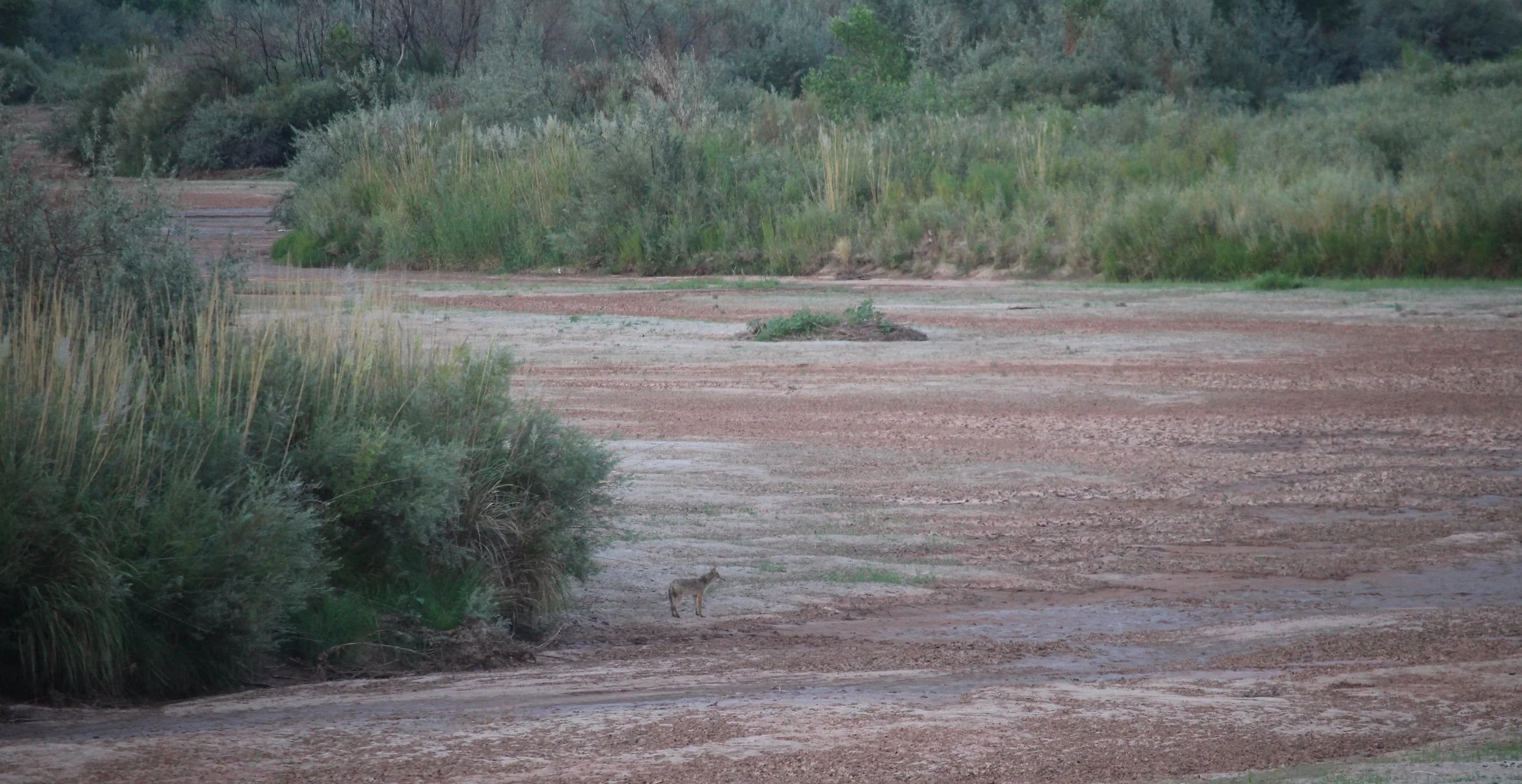
This summer, the Rio Grande through Albuquerque dried for a total of about 50 days spread over six unique drying events from mid-July through mid-September.
Since the late 1990s, the Middle Rio Grande has regularly dried during irrigation season. This can happen for long stretches south of Albuquerque, like through Los Lunas, Belen, and Socorro.
During many of those dry years, federal water managers worked with the Albuquerque Bernalillo County Water Utility Authority, for example, to lease San Juan-Chama water stored in upstream reservoirs. (That’s water piped from tributaries of the San Juan River into the Chama River, a tributary of the Rio Grande.) Then, the U.S. Bureau of Reclamation would release that water for spring pulses so endangered silvery minnows might spawn and sometimes, to minimize river drying when and where that was possible.
But in recent years, drying has been moving further upstream.
For a few days in July 2022, the Rio Grande dried in Albuquerque. Then, this summer, the Rio Grande through New Mexico’s largest city dried again — for a total of about 50 days spread over six unique drying events from mid-July through mid-September.
Those paying attention were shocked to see miles of sandy river channel, stretching from below downtown and nearly to the Alameda Bridge, where treated wastewater still trickled through the channel. But this summer, it felt as if something shifted. It felt as if the drying became something we’re starting to accept as “normal” within our collective consciousness.
By the end of October, the nights have gotten cooler. But the afternoon is still blazing hot as hydrologist Dagmar Llewellyn and I walk to the banks of the Rio Grande in Albuquerque. Llewellyn worked on Rio Grande issues for more than 25 years, most recently for the Bureau of Reclamation before she retired from the agency in early 2025.
“Sure, people reacted when it first dried this year,” says Llewellyn. “But there are a lot of other things to worry about right now. Every day, there’s a barrage of new, really existential problems to weigh on our minds.” Indeed, on the day we walked, President Donald Trump was talking about resuming nuclear testing.
In the past, there were also options to try and alleviate drying in the Middle Rio Grande — and keep people in Albuquerque from witnessing the impacts of overconsumption and climate change.
I first interviewed Llewellyn about river drying 23 years ago, and at the time of this recent conversation, we’d just spent two days in a workshop at the University of New Mexico, “Future Scenarios Planning for Drought and River Drying in the Middle Rio Grande.” This is an edited excerpt of part of our conversation along the river.
“The snow we do get disappears on the way down because it’s hot and the soils are dry. We just can’t really get water down into this desert anymore.”
LP: Why did the Middle Rio Grande dry this year?
DL: It's important to understand that the Rio Grande is not a natural system. It's an engineered system. It's managed on a daily basis by a consortium of agencies at all different levels of government plus municipal water users and irrigation districts. So partly, (drying is) a product of decisions.
It is also clearly a product of climate change because really, we didn't get any snow (last winter).
The snow we do get disappears on the way down because it's hot and the soils are dry. We just can't really get water down into this desert anymore.
On top of that, we have infrastructure problems like El Vado. It doesn't store water anymore. Now, we've made a temporary fix so we could put water into Abiquiu Reservoir — if we had it.
But the El Vado problem kind of eliminates a longer-term problem: For the foreseeable future, we're not going to be able to store water because of the Rio Grande Compact.
That does mean when we do have water in the mountains, we do let it run down through the system. But climate change is telling us that's coming earlier. There's less snow, and more of it gets lost along the way. Every single place where there's water use, the water use is more. And so, by the time it gets down here into the desert landscape, there isn't anything left.
That doesn't mean that's always going to be true. There could be big El Niño years when the ocean's warm and that generates more moisture and more moisture comes in the frontal systems and blankets the mountains with more, we saw in 2023, it was a lot more than expected.
But the big years are going to be smaller than they used to be, and the bad years are going to be smaller than they used to be. So (this year) was a particularly bad one.
(Note: On the Chama River, El Vado Reservoir can currently only store about 13 percent of the reservoir’s historic capacity. The dam is unsafe, and construction isn’t expected to resume for another three to six years. Also, under the Rio Grande Compact, New Mexico cannot store water in upstream reservoirs until the state has delivered a certain amount of water to Elephant Butte Reservoir for downstream users. And although people often say that water delivered to Elephant Butte and Caballo reservoirs is water for Texas, it’s important to note that 57 percent of that water is delivered to users in southern New Mexico.)
LP: Have you seen cumulative impacts of continued drying or continued low flows?
DL: We've been working our way towards a summer of no water in the Albuquerque reach for a long time.
We've seen that there's less and less water in storage. We've seen ourselves losing the storage, we've seen our problems with our compact debt. We've seen the silvery minnow, for God's sake, in terrible, terrible shape. We haven't had the kind of high sustained, high spring flows that we've needed since like 2005, I think.
The writing's been on the wall, but we finally hit that point where there's no water to release. It doesn't matter what legal finger wagging somebody does. There's no water to release. We can't do anything.
(UNM Professor Emeritus) Cliff Dahm wrote a paper (more than ten years ago) about how even then, the federal government and its operations, including the dams and reservoirs, are masking the impacts of climate change.
We kept the river flowing. We kept it looking like things were normal. Even as we started getting closer and closer and closer to when we couldn't do it anymore, without really letting the public have sight of that. Then, all of a sudden, it all breaks because we got to the end of our resilience abilities. So, the reservoirs did keep the river from drying. And that's good and bad.
“We know what to do. We're just not doing it.”
LP: Do you think that the Middle Rio Grande will someday look like the Lower Rio Grande in New Mexico (which is dry much of the year, except when the river channel is used to deliver water to downstream users)?
There's a chance. There's some likelihood.
LP: We already know that the climate is changing. What do you think we can do with that knowledge? I'm not saying we stop asking questions or studying impacts, but what should do with the knowledge we already have?
DL: We know a lot. We know what to do. We're just not doing it. Law and policy are not keeping up with what we know in terms of the science, in terms of what needs to be done. I really think that's where we need to focus. And boy, we've got some great lawyers and we're generating a whole bunch more out of this law school that we have here.
Like the thing that you're focusing on: Why doesn't the river have any rights? Well, let's work on giving the river some rights. Let’s give it the opportunity to create a system that actually can function.
LP: We perceive the compacts, like the Rio Grande Compact, as immovable, something that cannot be changed. Meanwhile, we’re not accepting that the climate has changed, the physical realities have changed.
DL: The compact is changing now. It took us the last 14 years in litigation, but it's going to change. I think it's going to wind up changing more into Texas's favor, which might not be what we want.
But it does also provide us some good here in New Mexico, which is it makes us flow this water down the river. Without (the compact and required downstream deliveries), I don't know that we would.
LP: I like to reimagine the world, to imagine that if we were to completely rework our system of water rights, where we start with rights for rivers….I think that people would be a lot better at conserving water.
DL: I think so, too. This was the point I was trying to make (at a recent workshop): Have all of these outrageous solutions on the list because you don't know when you're going to get your opportunity. You don't want to face a crisis and not be ready to really rethink things, mostly our legal systems.
We have to have a crisis to shake us up because we're really wedded to our current system right now. But (the crisis) is going to come. It's definitely going to come.
