Why not envision a better future?
Imagine for a moment that New Mexico prioritized water rights for rivers themselves.
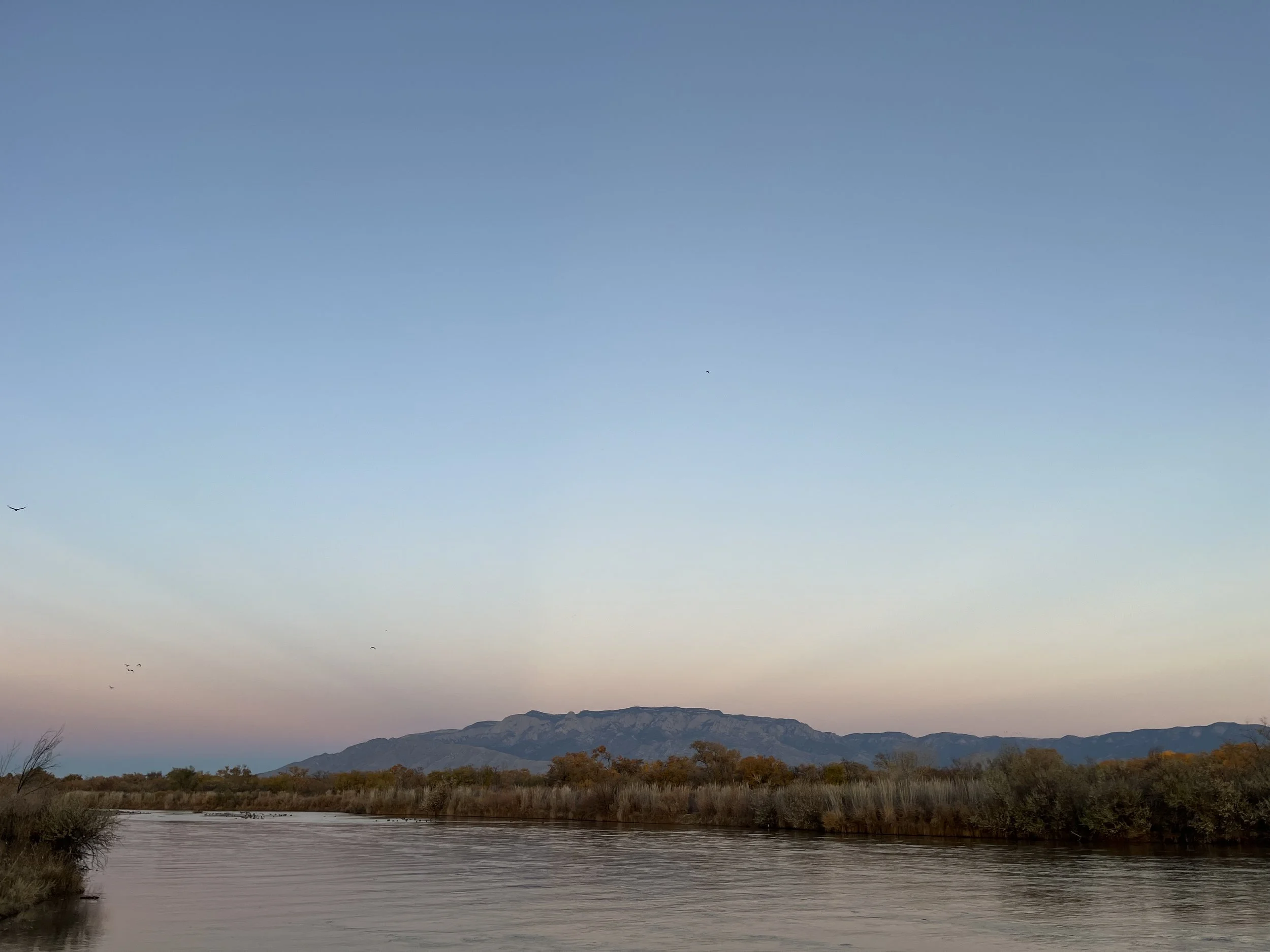
It’s mid-November. And my home river feels alive.
After the dry and disconnected conditions of the summer — when silence reigned in the sandy riverbed of the Middle Rio Grande — sandhill cranes, mallards and wood ducks, cormorants, Canada geese, herons, and crows fill the runway above the river.
It is messy and gorgeous and far from perfect.
Invasive elephant grass springs from the banks, and there’s tamarisk and Russian olive. Many cottonwoods and elms show the strain of the summer’s conditions, and I wonder if they’ll leaf back out next spring. Coyotes are calling. Sirens, wailing. And those dumb, noisy engines that seem to be everywhere lately are ripping up and down Coors Boulevard a mile away. There’s trash and the sickly-sweet smell of effluent in the river.
But the Rio Grande feels alive. And not just because of the raucous birds.
This past year, thousands of people read Robert Macfarlane’s book, Is a River Alive? In it, he writes about the waters near his home in England, as well as about watersheds and rivers in Ecuador, India, and Canada.
“It seems clear to me then, in the strange, bright water (of the Río Los Cedros) that to say a river is alive is not an anthropomorphic claim,” Macfarlane writes. “A river is not a human person, nor vice versa. Each withholds from the other in different ways. To call a river alive is not to personify a river, but instead further to deepen and widen the category of ‘life’, and in so doing — how had George Eliot put it? — ‘enlarge the imagined range for self to move in.’”
Of course, it’s one thing to nod an emphatic yes when asked if distant rivers are alive. Or to feel epiphanous while traveling far from the complexities of your home river or watershed. It’s quite another to embrace the long-term challenges of helping your local rivers and wetlands survive, especially if your elected officials, family members, food suppliers, and neighbors feel differently.
For example, is the Rio Grande alive when we allow the riverbed to dry — including through the southern stretches for much of the year? If the river is alive, how do we feel about taking away that life? How do we accept a future in which the river suffers, becoming drier for more days, weeks, and months out of the year?
About a decade ago, Denise Fort, then-director of the Utton Transboundary Resources Center at the University of New Mexico School of Law, asked me to write what was called “Environmental Flows Bulletin.” While researching and writing that newsletter, I learned so much about the state’s rivers and the policies that control them. And the work ignited an obsession: I believe that rivers deserve rights to their own waters.
(If I’m honest, the work at first ignited incredulity: Rivers don’t have rights to their own waters? What?!?)
This project picks up where “Environmental Flows Bulletin” left off, and gives me the chance to explore the state’s rivers — and their possible futures.
Imagine for a moment that New Mexico prioritized water rights for rivers themselves. Imagine a system that preserved a certain amount of water in rivers, first and foremost for the benefit of rivers and their ecosystems. Imagine how much better humans might be at conserving — and sharing — the waters that rivers provide.
The climate has changed, and the Southwest will continue to warm and dry — putting all our waters at risk. The federal government, together with the funding it’s brought to river restoration, wildlife refuges, endangered species recovery, and more, is in disarray, likely for decades or longer. Political manipulation has divided people, even families, who have shared goals and values. Many people feel overwhelmed or hopeless.
So…why not envision a better future for our rivers? What do we have to lose?
These are all questions to explore. So, let’s go. Together.
