Pilot Project Seeks to Make a Splash
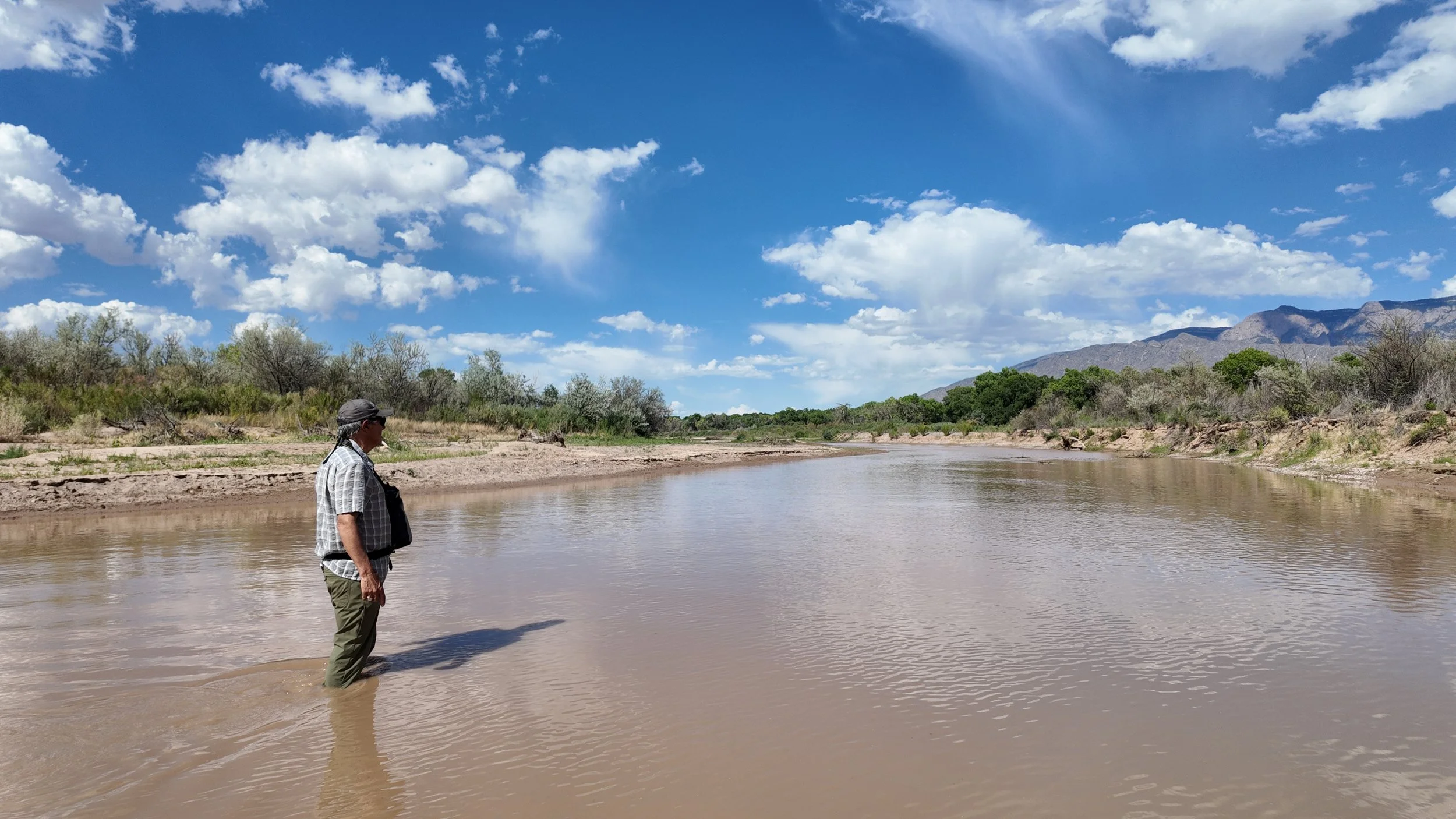
Audubon New Mexico’s Paul Tashjian stands in the Rio Grande north of Albuquerque after summer storms briefly bumped up flows in mid-June.
In sandals, with his camera in a dry bag around his neck, Paul Tashjian crosses the Rio Grande north of Albuquerque. On a Monday afternoon in mid-June, the river’s muddy waters slide past the Pueblo of Sandia and the Village of Corrales at about 40 cubic feet per second — four percent of the normal flow for this time of year.
Barely getting his shins wet, Tashjian, a hydrologist, heads to what’s called an outfall on the east side of the river. It’s where irrigation water diverted upstream can be returned to the river channel.
“If you go to places in the river where it’s dry, like in central Albuquerque now, you don’t hear birds,” Tashjian says. “You come to a place like this where there’s water, there’s a much different feel to it, a different sound. You hear the use of [the water].”
Here, a trickle pours over a breached beaver dam. Frogs jump into the water. A yellow-breasted chat’s stuttered song sounds like a rattlesnake or cicada. Small fish, including Rio Grande Silvery Minnows, find refuge in the cooler waters flowing through the wetland.
A former U.S. Fish and Wildlife Service employee, Tashjian is the Director of Freshwater Conservation for Audubon New Mexico, which runs a pilot project in cooperation with the Middle Rio Grande Conservancy District.
Together, they’re trying to support tiny wetland habitats by releasing small amounts of water through outfalls like this one.
This year, Audubon New Mexico is leasing about 1,000-acre feet of water from the cities of Bernalillo, Belen, and Los Lunas. Meanwhile, the Middle Rio Grande Conservancy District leases water from willing farmers who want or need to take a year off planting and irrigating.
Of the dozens of outfalls in the Middle Rio Grande, the project currently delivers water to just a few, trying to patch the river along in dry times. “When we started working with this program, we never thought we’d be talking about Albuquerque,” says Tashjian. They were focused on river stretches south of city, which have dried regularly since the early 2000s.
“It seems like every year is a new bar in terms of like, ‘This is the driest year on record,’” he says. But this year — with a lack of snowfall, little water stored in upstream reservoirs, and high temperatures early in the year — walloped the Rio Grande. “It feels like it’s so much harder this year,” he says.
Drying in the Middle Rio Grande began this year in April. As of June 22, there are more than 80 miles dry in six separate reaches.
Seeing a “hard dry” through Albuquerque is awful, he says. But people need to witness the drying — and take action. There are opportunities to offer public input on state programs and initiatives. And during the next legislative session, Tashjian is optimistic lawmakers will implement and staff a new program related to environmental flows or instream flow rights.
In New Mexico, rivers don’t have any rights to their own waters. But people can change that.
“We’ve got to decide as a state, and in the city, do we want to protect our rivers? If we do, we’ve got to put our money and our efforts behind it,” he says. This year’s conditions drive home the seriousness of the water crisis and vulnerability of our rivers, he says. From tiny mountain tributaries to the state’s largest waterways, river flows and the ecosystems they support are suffering.
“We’re at a crunch point,” he says, looking around at the river, which he calls “remarkable” for all the life it supports in the valley. “We’ve really got to amp up taking it more seriously.”
